why hello
it's incredibly sunny outside !
and i can't stop pausing every hundred feet because i come across tulips, or a tree, or the lagoon, or whatever.
it's amazing how beautiful nature is. i love this type of weather.. sun shining, 70degrees, and a cool breeze. juust perfect. =)
turn this song up !
clazziquai - love mode (feat. tablo)
my favorite part is where tablo raps. keke.
vexed and stressed out gotta confess now
fallen angel's with no where to nest out
pull my chest out try my best to breathe
but i'm frantic it must be my asthmatic destiny
"asthmatic destiny". haha. i just like that phrase.
anyway...
i took my first final on wednesday for art history. wasn't too bad. the questions weren't exactly predictable but they were simple enough for me to answer. here's a question that i would like to share and the answer that i provided. i'll try to recall the best to my ability. =) i hope i don't get in trouble for putting this question up because i took this exam early so i'm sure the other half of the class will have a different prompt.... right? =\ i hope.
question:
many will call monet an artist who invented a new way of painting landscapes. but there is no doubt that he integrated styles and ideas from other artists. identify all the paintings (on the screen) and explain how monet enhanced his landscape paintings through other artists. (you are strongly encouraged to name another artist and another work of Monet).
my response:
Claude Monet can easily be construed as the most innovative landscape painter of Impressionism. But like every other artist he worked as a response to aritsts, or was taught by them, or was simply influenced by them. Right before Impressionism was the period called Realism. Gustave Courbet was one of the leading painters of the time and Monet learned a great deal from Courbet. Monet's Etretat: Rough Sea (1883, oil on canvas) is a great example of this. Courbet also painted this same scene; Monet took it one step further. Monet added life and the "feeling of the moment" in the waves. The waves look as if they're going to crash the shore anytime soon and then suddenly fall and disappear out into the ocean. In just a few seconds this would all take place.
Another great influence in Monet's life was the Japanese. The Japanese prints were popular in Paris in the 1860s because of the unique coloring and cropping methods. Their view of perspective was something that also intrigued artists at the time--including Monet. The Boulevard des Capucines (1873-73, oil on canvas) displays the aspects of the Japanese prints. The painting is cropped severely--on the right side of the canvas, there are people sticking out of probably some building which actually happens to be Nadar's Studio, where the first Impressionism Exhibition was held. The perspective isn't that hard to grasp but at the same time the trees seem to lead somewhere unknown. Lastly, he has some structure to this painting by separating the people with the carriages, and the depth of perception of the trees and the street. And even though Monet took ideas from the Japanese prints, he added his own twist by making the people look like tongue-lickings rather than actual people with details. A second example of the influence of Japanese is Monet's waterlilies. His Waterlilies (1903, oil on canvas) are the most striking things from all of Monet's collection. Not only has Monet cut off the horizon and eliminated the sky, he has zoomed in on what's most important--the waterlilies. In the waterlilies, Monet mirrored the philosophies of Japanese art. Japanese art emphasized the transience of nature. The fact that they are not clearly painted with great detail reflects that life is like a big blur.
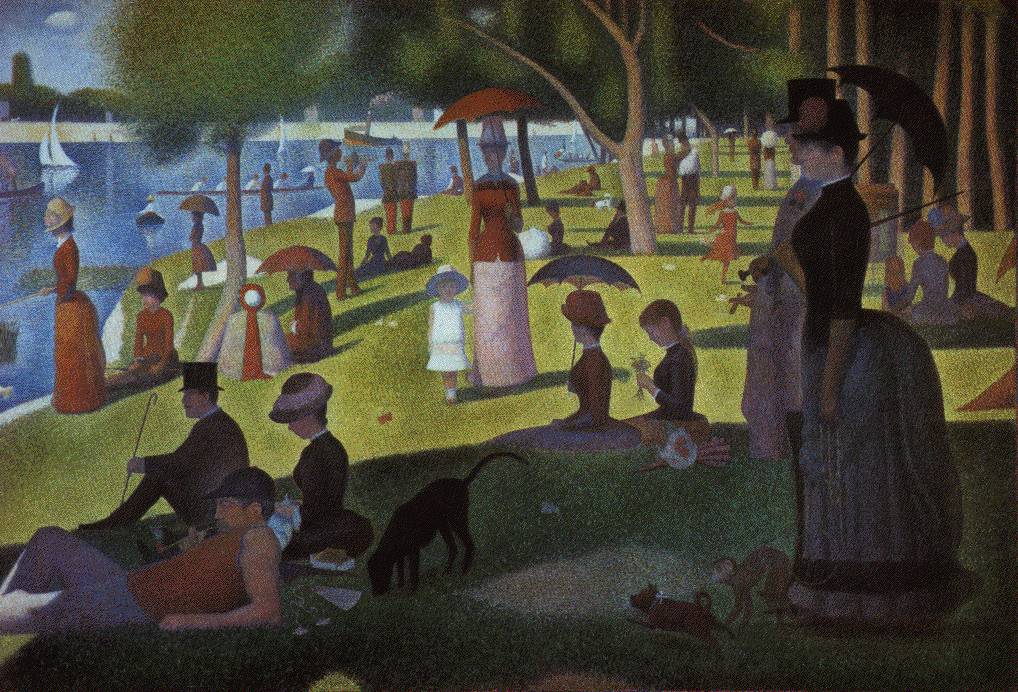
An artist that challenged Claude Monet at one point was Georges Seurat. He introduced pointilism and divisionism into the realm of Impressionism. Seurat wanted to bring logic into the illogic Impressionism. He studied the color wheel and through divisionism he demonstrated that by painting contrasting colors you can accent a certain color. For example in Seurat's Sunday Afternoon on the Island of La Grand Jatte (1885, oil on canvas), there are dots of orange within the brighter green grass so that the green looks even more green than before. Upon closer inspection, there are also red dots in the little girl's white & blue dress and hat. And through pointilism he painted in dots so that the colors would be enhanced and that the painting would have more structure. Seurat didn't care about the "momentary feeling" of Impressionism but rather the logic of the painting. Claude Monet responded to this painting through his Grainstack series. One of the series, Grainstack in the Sunlight (1891, oil on canvas), directly reflects the pointilism and divisionism that Seurat invented. In the shadow and grass of the there are mixes of blue and orange to reflect the coolness of the shadow in the sunlight. There is also green in the orange in the grass in the sunlight. Monet also used extremely short brushstrokes to emphasize the colors.
...........okay to be quite honest, there was actually a lot more that i wrote. but i'm really tired and i wanna freakin' finish this post that i started like 4 days ago.
the year is coming to a close. here's a snapshot of what's gonna happen in the following weeks.
may9th - 12:30-3:30pm stats exam // 4-7pm ochem lab exam
may11th - moving into courtney's
may12-19th - chapter focus week !
may20th - coming back to chicago
may29th - start summer school. for summer school i'm taking phys142. at least the class is later in the day than last summer. MTWF i have class from 12:00-1:40pm. and then on mondays i have lab from 2-5:20pm. haha. 3hr 20min. lab? piece of cake. =) half of what it is for me for chemistry. whew !
sophomore year. dang. passed. i need to be better at remembering what happened this year. but i'll do a recap later when i have more time. =D
gotta sleep so i can be well-rested for church !


 Posts
Posts


stumble upon ur blog~ its beautiful~ ;) After reading ur post find that ur someone who does think alot abt life and living happy~! :D like moi~ anyway take care have fun~
Anonymous said...